
Placing one person on a project stay is simple. Placing a whole crew on a multi-week or monthly assignment in Bromley is a different job, and it usually lands on a site manager, project coordinator or office manager who has a build to run, not a booking to fuss over. This guide is the booking-and-management workflow for that person: how many units to hold and in what bedroom mix, where the monthly rate beats the weekly one, what to put in your accommodation policy so finance does not get surprised, the parking and early-start details that make or break a trades crew, and a short brief you can send a provider to get a fast quote.
It assumes you have already decided that serviced accommodation suits a working team. If you are still weighing that, the wider picture sits in our pillar on serviced accommodation for contractors in Bromley, which covers cost, length of stay, location and what is included. This page picks up where that leaves off and deals only with booking and running the team stay.
Step 1: Size the booking to the crew
Start with headcount and how the team expects to live, then translate that into units and bedrooms rather than rooms. The cheapest arrangement on paper is rarely the one that keeps a crew rested and on site at 7am, so size it for the work, not just the spreadsheet.
A few patterns hold up well for trades teams:
- One bedroom per worker is the baseline. People sleep better in their own room, and a rested crew is a productive one across a multi-week run.
- Two or three sharing a self-contained apartment gives each worker a private bedroom while a kitchen, bathroom and living space are shared. A six-person crew sits comfortably in two three-bedroom units, or three two-bedroom units if you want smaller groups.
- Singles or studios for the leads. A supervisor, foreman or anyone on an early or odd shift usually warrants their own unit so the rest of the team does not wake them, and so calls and paperwork can happen in private.
- Mixed shifts split by unit. If part of the crew starts at first light and part runs late, group them by shift across separate apartments so one half is not woken by the other.
Write the bedroom mix down before you approach a provider. "Six beds, ideally two three-bedroom apartments, one extra single for the supervisor" is a brief a provider can quote against in minutes. "Accommodation for six" is not.
Step 2: Compare weekly against monthly, and find the break-even
Serviced accommodation is normally priced lower per night the longer the booking runs, so the rate you are quoted depends heavily on how you frame the stay. Weekly rates suit a job of a fortnight or so. Monthly rates win for anything that runs close to, or beyond, four weeks, and the gap widens the longer the team stays.
There is a tax reason the monthly figure drops further than you might expect. Under HMRC's reduced value rule, where one person occupies the same accommodation for more than 28 continuous nights, from the 29th night VAT is charged only on the part of the price that is not for the accommodation itself, with at least 20 percent of the remainder treated as the serviced element. The practical effect is a materially lower effective rate on long stays. The detail is set out in VAT Notice 709/3 on GOV.UK, and any serious provider will already price it in for a 28-night-plus booking.
So the break-even question is simple: ask for both the weekly and the monthly quote across your real assignment length, then compare the totals rather than the headline nightly figure. A stay of three weeks may be cheaper on a weekly rate; the same crew for five weeks is almost always cheaper monthly once the long-stay treatment kicks in. Our line-by-line breakdown on the cost of contractor accommodation in Bromley shows where those numbers tend to settle for a team.
Step 3: Set the accommodation policy before you book
The bookings that go wrong rarely go wrong on the night. They go wrong six weeks later, when finance receives a stack of separate nightly receipts with VAT they cannot reclaim cleanly and charges nobody warned them about. A short accommodation policy, agreed before you book, prevents most of that.
Put these terms in writing with the provider:
- A single monthly invoice in the company name. One consolidated bill covering every unit, not a receipt per worker. It is far easier to reconcile, approve and reclaim against.
- A proper VAT invoice. Confirm the provider is VAT registered and will issue a compliant invoice, so the cost is reclaimable where your business is entitled to.
- No nightly pricing surprises. A fixed rate for the booked period, with utilities, Wi-Fi and any cleaning stated as included. Get any extra charge, such as additional cleans or late check-out, named upfront.
- One clear cut-off and amendment policy. Crews change. Know in writing how to add a worker, drop a unit or extend by a week, and what notice each needs.
- A named contact for the stay. One person to call if something breaks at 6am, rather than a general inbox.
Industry providers of corporate housing routinely consolidate a whole team onto one transparent VAT invoice, so this is a reasonable thing to insist on rather than a favour to ask for. If a provider cannot or will not give you a single invoice and a fixed rate, treat that as a reason to look elsewhere.
Step 4: Get the parking and early-start logistics right
For a trades crew, two practical details outrank almost everything else: where the vans go, and how the team gets in and out before anyone is awake.
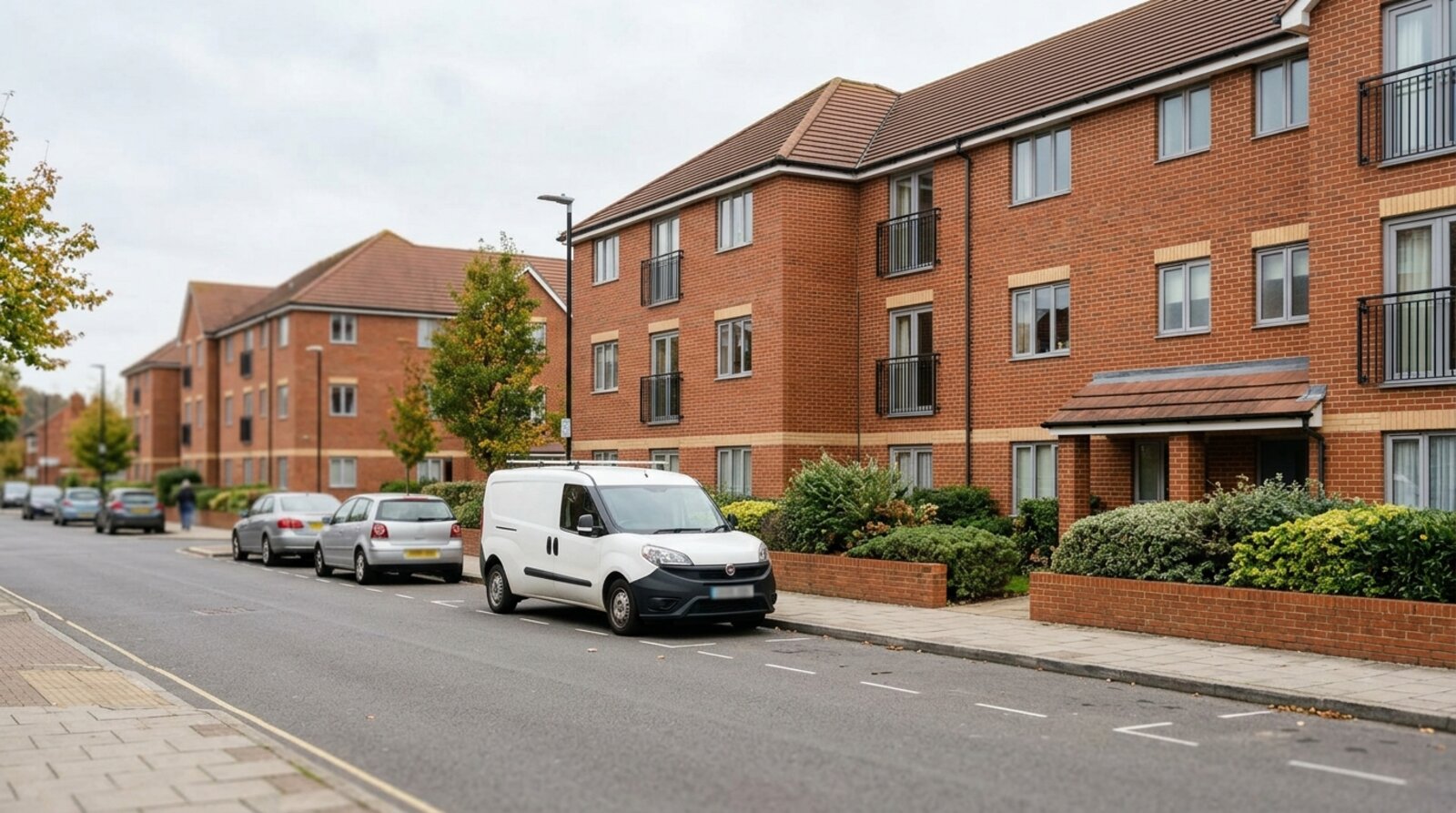
Parking is the first question to ask, not the last. Confirm how many cars and vans can be left on site or close by, and whether a residential permit is needed, because Bromley has controlled parking in parts of the town centre. A crew that has to circle for spaces every morning loses time and patience. If the team runs sign-written vans or carries tools overnight, ask about off-street or secure parking specifically.
Early starts mean the crew will leave before any office or reception opens. Self check-in, keyless entry or a keysafe removes the bottleneck of collecting keys during business hours, and lets a team arrive late on a Sunday and start work first thing Monday. Ask how access works on arrival day and whether keys can be split so each unit lets itself in.
Location ties both together. Stays within a short drive of the work site cut commuting at the start and end of a long day. Bromley itself is well placed, with fast services into central London if part of the team needs the city, covered in our guide to getting around Bromley.
Step 5: Check the Wi-Fi, kitchen and laundry the team actually needs
A working crew lives in the accommodation, it does not just sleep there, so the in-unit facilities matter more for a team than they would for a one-night business trip.
- Reliable Wi-Fi. Site photos get uploaded, drawings get pulled up, supervisors join calls. Confirm it is included and ask roughly what speed, rather than assuming.
- A real kitchen. Teams on a multi-week stay cook rather than eat out nightly, which keeps subsistence costs down and morale up. A full kitchen with a hob, oven, fridge and a dishwasher pays for itself across a month.
- Laundry. Work clothes need washing and drying between shifts. In-unit or on-site laundry is close to essential for a crew; a launderette run on a Saturday is not a plan.
- Living space. Somewhere for the team to eat and sit together turns a stack of rooms into a base, which matters over weeks rather than nights.
None of these are luxuries for a team stay. They are the difference between a crew that settles in for a month and one that is unhappy by week two.
Step 6: Brief a provider so they can place the team fast
You will get a quick, accurate quote if you give a provider what they need in the first message rather than across ten emails. Four facts do most of the work:
- Team size and how they will share. "Six workers, happy to share apartments but each needs their own bedroom, plus one single for the supervisor."
- Duration and start date. "Five weeks from 23 June, possible one-week extension." This is what triggers the monthly rate and the long-stay VAT treatment.
- Work site or area. Naming the site or the part of Bromley lets the provider quote the right units rather than the nearest available.
- Must-haves. Parking for two vans, self check-in for an early start, and a single VAT invoice. List the deal-breakers so the quote already meets them.
Send that a few weeks ahead where you can. Single rooms are easy to find at short notice; several units in one location, with parking, for the same dates are harder to assemble late, and the better team stock books up first.
Pre-booking checklist
Before you confirm a team booking, run through these. If any answer is unclear, get it in writing first.
- Headcount and bedroom mix decided, with singles for leads and odd shifts.
- Both weekly and monthly quotes obtained and compared across the real stay length.
- Long-stay VAT treatment confirmed for any 28-night-plus occupancy.
- One consolidated monthly VAT invoice in the company name, fixed rate, bills included.
- Parking confirmed for every vehicle and van, permits checked.
- Self check-in or keyless access arranged for early or out-of-hours arrival.
- Wi-Fi, full kitchen and laundry confirmed in each unit.
- Amendment and cancellation terms understood for adding, dropping or extending.
- A named contact for the stay, reachable outside office hours.
Get those nine right and a team booking runs quietly in the background while you get on with the build. If you want to talk through a specific crew and dates, start from the Bromley Short Lets homepage and send the four-line brief above.
Frequently asked questions
How many units should I book for a contractor team?
Work from headcount and how the crew expects to live. A common pattern is one bedroom per worker, with two or three sharing a self-contained apartment so a kitchen and living space are shared but bedrooms are private. A six-person crew often sits comfortably in two three-bedroom units or three two-bedroom units. Lead trades, supervisors and anyone with an early or odd shift usually warrant a single room or a studio so their sleep is not broken by the rest of the team.
Is a monthly rate cheaper than booking by the week?
Usually, yes. Serviced accommodation is normally priced lower per night as the booking lengthens, and monthly rates beat weekly ones for any stay that runs close to or past four weeks. There is also a tax effect: where one person stays more than 28 continuous nights, HMRC's reduced value rule means VAT is charged only on part of the price from the 29th night, which lowers the effective cost of a long stay. Ask the provider for both the weekly and the monthly figure and compare them across your real assignment length.
Can I get a single invoice for the whole team?
Yes. Ask for one consolidated monthly invoice in the company name covering every unit, rather than separate nightly receipts per worker. A single VAT invoice is far easier to reconcile and to reclaim against, and it removes the risk of surprise nightly charges appearing later. Confirm in writing that the rate is fixed for the booked period and that bills such as utilities and Wi-Fi are included.
What does a contractor team need beyond a bed?
Reliable Wi-Fi, a real kitchen, in-unit or on-site laundry, and somewhere to park. A working crew cooks rather than eats out every night, dries work clothes between shifts, and often needs to upload site photos or join calls. Parking matters most: confirm how many vehicles and vans can be left on site or nearby, and whether a permit is needed. Early starts mean the team will leave before any reception opens, so self check-in and keyless or keysafe access save a lot of friction.
How do I brief a provider so they can place the team quickly?
Give four things in the first message: team size and how they will share, the duration and start date, the work site or area in or near Bromley, and your must-haves such as parking, an early-start arrival and a single invoice. With those, a provider can check availability and quote against the right units straight away instead of trading emails. Send it a few weeks ahead where you can, since the better-located stock for teams books up first.
How far ahead should I book accommodation for a team?
As soon as the assignment dates and headcount are firm. Single rooms are easy to find late, but several units in the same location, with parking, for the same dates are harder to assemble at short notice. Two to four weeks of lead time gives a provider room to hold the right mix together and lock the monthly rate before the stay begins.