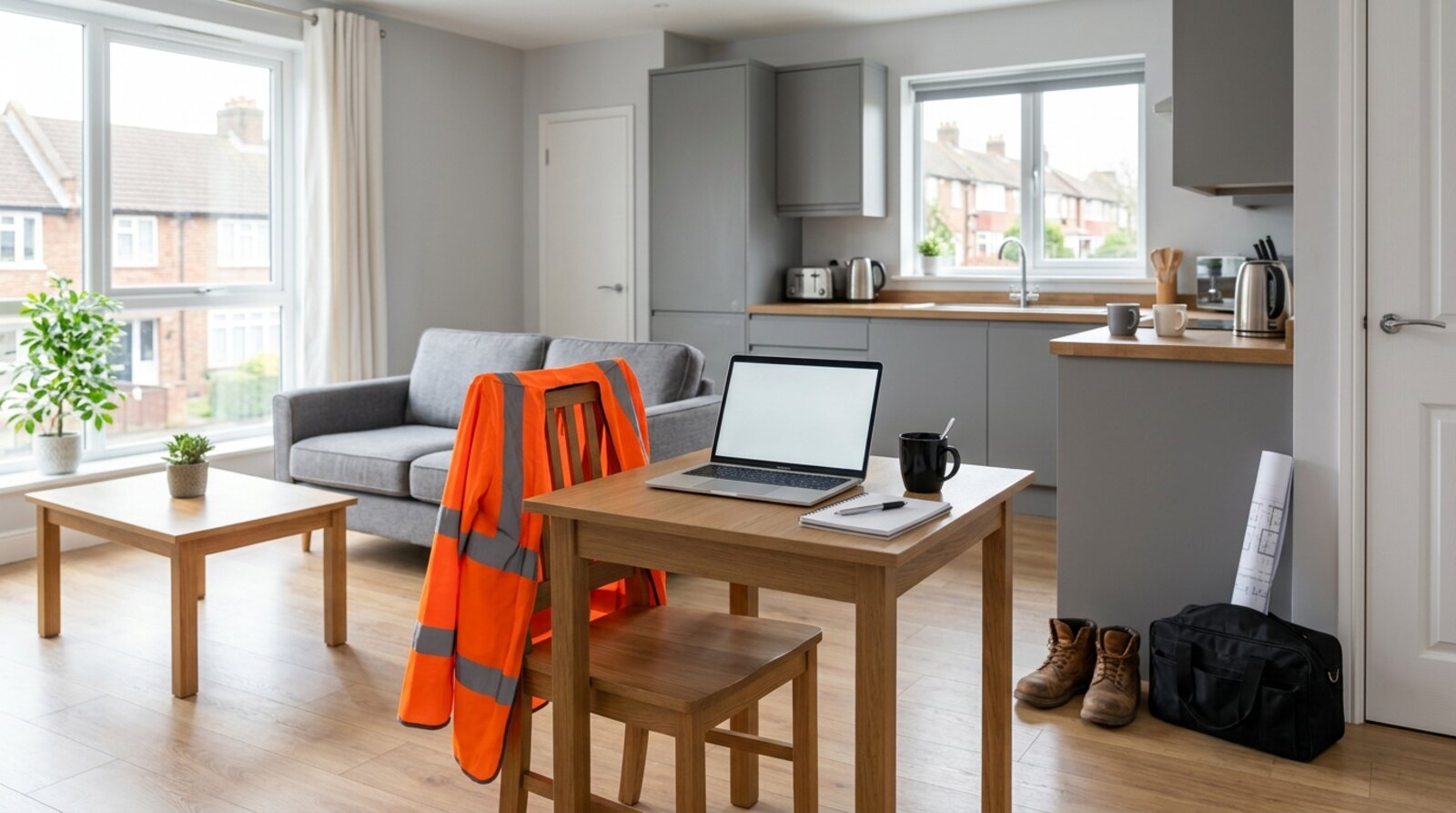
Booking a place for yourself is simple. Booking for a working crew is a different job: you are juggling dates, headcount, a finish line that might move, and a finance team that wants one clean invoice at the end. This guide walks through the booking process for housing a contractor team in Bromley, in the order you actually need to make the decisions. It is written for whoever picks up the task, whether that is a site manager, an office manager, a project coordinator or someone in HR.
If you are still weighing up serviced accommodation against hotels and want the background first, our guide to serviced accommodation for contractors in Bromley covers the why. This page is the how.
Step 1: Work out how many units and bedrooms you need
Start with headcount and the sleeping arrangement, because everything else (price, location, dates) follows from it. Two questions settle most of it.
- How many people, and for how long? A two-week snagging visit by three trades is a different booking from a six-month fit-out crew of eight.
- Will they share, or does everyone need their own room? A two-bedroom house with twin or single beds can sleep four comfortably and keeps the cost per head down. Separate one-bedroom units cost more but suit mixed crews, long stays and anyone on shift work who needs to sleep at odd hours.
A rough rule that works for most teams: a two-bedroom house for up to four people who are happy to share, or one bedroom per person for everyone else. Sketch the crew list, mark who can share and who cannot, then count the units. That number is what you ask providers to quote against, so the figures come back accurate the first time. Our 2-bedroom house in Petts Wood and 1-bedroom flat in Bromley show the two configurations most teams mix and match.
Step 2: Choose the length of stay, and leave room for overruns
Length of stay drives the rate. Weekly rates give flexibility; monthly rates are normally cheaper per night. The trick is matching the rate to how confident you are about the end date.
- Fixed, short project (a few weeks): book weekly. You keep the option to hand units back, or extend one more week, without committing to a month.
- Settled, longer project (a month or more): book monthly for the better rate, but ask up front what notice is needed to extend.
- End date uncertain: this is most building work. Ask whether you can start monthly and roll on week by week if the job overruns, rather than being forced into a fresh month for the sake of a few extra days.
Projects slip, so treat overrun terms as part of the decision, not an afterthought. To see how weekly and monthly figures stack up for a real crew size, our page on what serviced accommodation in Bromley costs breaks the numbers down, and the contractor guide links a hotel comparison if you want to check the saving against rooms.
Step 3: Pick a location near the job site and transport
For a working team, the right location is the one that cuts dead time at the start and end of each day. Measure it in commute minutes to the site, not in distance on a map.
Bromley and Petts Wood sit on good road and rail links into the rest of south-east London and Kent, which matters if your job site is not in Bromley itself.
- By road: the A21 runs through Bromley, heading north towards Lewisham and central London and south towards the M25 and Sevenoaks, so vans can reach most south-east London and Kent sites without crossing town.
- By rail: Bromley South sits on the Chatham Main Line, about 17.5 km from London Victoria, with up to eight trains an hour to Victoria in the off-peak, run by Southeastern and Thameslink, according to the station record on Wikipedia. That suits crews working central London sites without a vehicle.
- Parking: if the team drives vans, parking is often the deciding factor. Ask whether a unit has off-street parking or a permit zone, and how many vehicles it can take, before you fix on a property.
Petts Wood, a short hop south, is quieter and residential, which some crews prefer for sleep after long shifts. Our Bromley guide has more on getting around the area.
Step 4: Check what is included for a working team
A team needs different things from a tourist. Run through this checklist before you book, because the right kit on site is what keeps a crew fed, rested and out the door on time.
- A real kitchen: a full kitchen lets the team cook after a shift and keeps food costs down, which adds up fast over a long stay compared with eating out every night.
- Laundry: a washing machine on site means work clothes get cleaned without launderette trips or a pile of kit going home at the weekend.
- Fast, reliable WiFi: needed for site paperwork, video calls with the office and the crew's own downtime. Confirm it is included, not an add-on.
- The right bed configuration: twin or single rooms for sharing, doubles where someone needs one. Spell out who needs what so the units are set up correctly on arrival.
- Cleaning: check how often the unit is cleaned and whether linen and towels are changed, especially on a long stay.
Step 5: Set up a single point of contact
The fastest way to lose a morning is five workers each phoning about five different problems. Channel it instead.
- Nominate one person on your side who owns the booking: changes, extensions, issues, all go through them.
- Ask the provider for one named contact too, so you are not starting from scratch every time you call.
- Agree how out-of-hours problems are handled, for example a lockout or a heating fault on a Sunday, before anyone needs it.
One contact each way keeps a multi-unit booking calm and stops small issues turning into site delays.
Step 6: Sort billing, invoicing and VAT
This is the part finance cares about, and getting it right up front saves a month-end scramble. Cover these points before you confirm.
- One consolidated invoice: ask for a single invoice covering every unit and every night, rather than separate bills per flat. It is far easier to reconcile.
- Pay by company account: confirm you can pay by company bank transfer, and check the payment terms (for example net 30) and the billing cycle.
- Purchase order references: if your finance team uses POs, ask for the reference to appear on the invoice so it matches your records.
- VAT: where the provider is VAT registered, standard-rated VAT applies, and a VAT-registered business can normally reclaim it with a valid VAT invoice. HMRC also operates a long-stay rule: where a guest stays in a qualifying establishment for a continuous period of more than 28 days, then from the 29th day VAT is charged only on the part of the payment that is not for the accommodation. Confirm the provider's VAT status and check the detail with HMRC's guidance on hotels and holiday accommodation or your accountant.
Confirm all of this in writing alongside the dates and unit list, so there are no surprises when the invoice lands.
A short booking checklist
Pulling the steps together, here is what to have ready when you make the booking:
- Crew list, who can share, and the unit count that falls out of it
- Start date, likely end date, and your overrun plan
- Commute target to the job site, plus how many vehicles need parking
- Your must-haves: kitchen, laundry, WiFi, bed configuration, cleaning
- Your single point of contact, and the provider's named contact
- Billing setup: one invoice, payment terms, PO reference, VAT status
Work through it in order and a team booking stops being a guessing game. When you have your numbers, get in touch with Bromley Short Lets with the crew size, dates and your job site location, and we will quote against the actual booking rather than a rough estimate.
Frequently asked questions
How far in advance should I book serviced accommodation for a contractor team in Bromley?
Aim to confirm two to four weeks ahead for a small crew, and earlier if you need three or more units on the same dates or your stay runs over a busy period. Larger teams take the most planning because matching dates across several flats and houses is harder than holding one room. If your dates are not fixed yet, ask whether the provider can pencil in units and confirm later.
Is it cheaper to book weekly or monthly for a team?
Monthly rates are usually lower per night than weekly rates, so a stay of a month or more is normally better value billed monthly. For shorter projects, or where the finish date is uncertain, a weekly rate gives you the flexibility to extend or hand back units week by week. Ask about both rates and about what notice is needed to extend before you commit.
Can I get one invoice for the whole team and pay by company account?
Yes. Many serviced accommodation providers issue a single consolidated invoice covering every unit and every night, and accept payment by company bank transfer. Confirm the billing cycle, the payment terms and whether a purchase order reference can be shown on the invoice so it matches your internal records.
Is VAT charged on serviced accommodation, and can my business reclaim it?
Where the provider is VAT registered, standard-rated VAT applies and a VAT-registered business can normally reclaim it provided it holds a valid VAT invoice. HMRC also operates a long-stay rule: where a guest stays in a qualifying establishment for a continuous period of more than 28 days, then from the 29th day VAT is charged only on the part of the payment that is not for the accommodation. Always confirm the provider's VAT status and check the rules with HMRC or your accountant.
Should the team share units or have a bedroom each?
It depends on the crew and the budget. Sharing a two-bedroom house keeps the nightly cost per head down and works well for settled teams, especially with twin or single configurations. Separate units cost more but suit mixed crews, longer stays and anyone working different shifts. Decide the sleeping arrangement before you ask for a quote so the figures are accurate.